

doximityask
June 15, 2026
How Residents Are Using Doximity Ask as as a Pre-Rounds Thinking Tool

# Residency
# Consults
How to structure your prompts for faster, sharper clinical case consultation

Dr. Peter Alperin
You're on a busy floor. You have a patient with atrial fibrillation and renal impairment. You need to make decide on anticoagulation, fast, and with confidence. Your attending is tied up. Other tools requires five clicks and a login.
This is the moment residents have started using Doximity Ask as their AI attending.
Clinical case consultation has emerged as the top use case among residents using Doximity Ask. Residents aren't browsing, they're asking specific, patient-level questions and acting on the answers within the same workflow.
What This Looks Like in Practice
The most common pattern is a structured, case-level prompt: patient context + clinical question. The more specific you are, the better the answer.
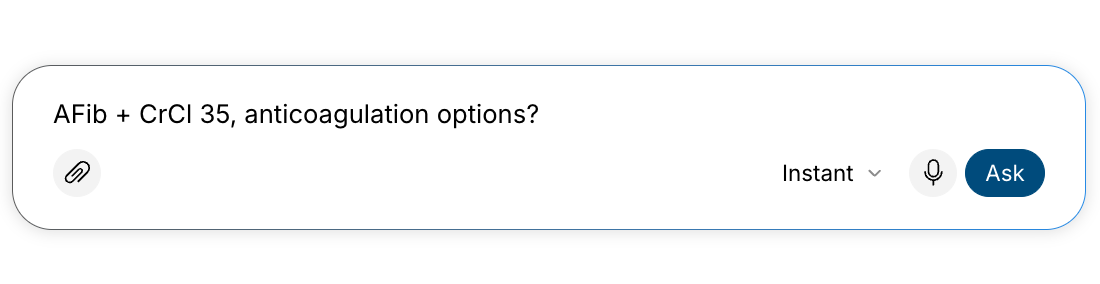
Less effective:
What are the anticoagulation options for AFib? More effective:
64-year-old with AFib and CrCl of 35. She's also on metformin and lisinopril. What anticoagulation options are safest? rAre there any contraindications? The difference is context. Doximity Ask handles nuance; it can factor in renal function, drug interactions, and co-morbidities when you give it that information upfront.
A Simple Prompt Framework
Think of it like writing a consult:
- Patient snapshot: age, key co-morbidities, relevant labs
- The clinical question: specific and answerable
- What you already know or tried: optional, but gets you a more targeted response
72M with COPD and new-onset type 2 DM on metformin. A1c is 9.2. He's already on tiotropium and salmeterol/fluticasone. What second-line DM agent would you avoid and why? Try it in Doximity Ask. 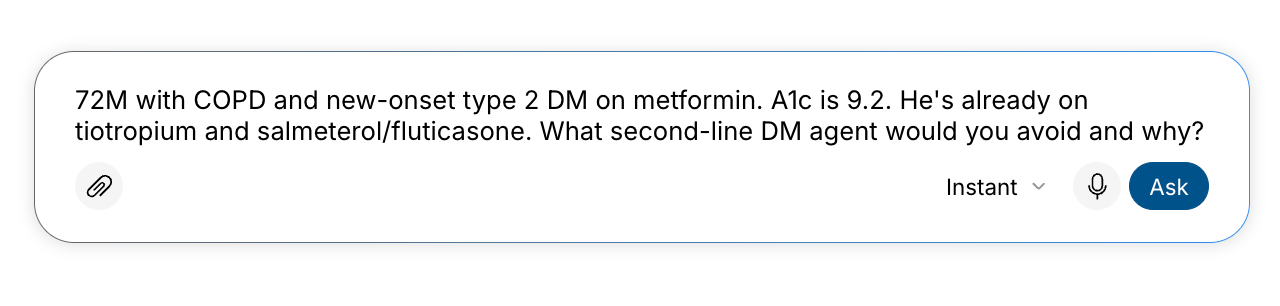
When It's Most Useful
- Pre-rounds prep: working through cases before your attending arrives
- Cross-coverage: unfamiliar patients, quick orientation to their complexity
- Procedures you haven't done in a while: refreshing the clinical rationale
- Enhancing the differential: "What am I missing for this presentation?"
The highest-volume use happens in the morning before rounds and late at night during overnight call, exactly when a second opinion is hardest to get.
A Note on Privacy
Doximity is HIPAA-compliant, so you can include patient-specific details in your prompts without stepping outside a secure clinical environment.
One Caveat Worth Naming
Doximity Ask is a clinical AI tool, not a replacement for clinical judgment, your attending, or a formal consult. Use it to think more clearly, not to skip the thinking. For complex cases, it's a starting point for the conversation, not the end of it.
Try It Now
The fastest way to build comfort with this workflow is to start with a case you already know the answer to. Ask Doximity Ask what you'd ask a colleague, then compare the response to what you'd say.
Part of the Doximity Academy series: Resident AI Workflows. Each article covers one of the top five ways residents are using Doximity Ask today.
Dive in
Related
Education
Using AI Alongside Your EHR: How to Use AI as Your On-Call Coder and EHR Co-Pilot (Part 2/3)
May 13th, 2026 • Views 61
Education
Using AI Alongside Your EHR: How to Use AI as Your On-Call Coder and EHR Co-Pilot (Part 2/3)
May 13th, 2026 • Views 61